The American Academy of Dermatology encourages the public to celebrate their skin, and all that it does for their health, by following healthy skin habits that dermatologists recommend
ROSEMONT, Ill. (Nov. 2, 2026) — Your skin works hard for you every day, quietly shielding you from the outside world while telling a story about what is happening on the inside. This November, the American Academy of Dermatology (AAD) is marking National Healthy Skin Month with a simple message: love and protect the skin you’re in. Give it the everyday care it deserves, while understanding when to bring in a board-certified dermatologist — the expert who can evaluate your skin, hair, and nails for clues about your overall health, not just what is happening on the surface.
“Healthy skin is skin that can do its job well,” said board-certified dermatologist Rachel Nazarian, MD, FAAD. “It keeps our bodies comfortable, regulating temperature and acting as a shield that protects us, both from physical debris and harmful germs, viruses, and bacteria. It is skin that has been loved and cared for through gentle cleansing, hydration, and sun protection. In a nutshell, healthy skin is skin that takes care of us while we take care of it.”
Protecting and repairing the skin barrier
At the center of healthy skin is the skin barrier, the outermost layer of the skin. The skin barrier acts as a protective shield, serving as the first line of defense against pollution, environmental damage, inflammation, and infection. It also keeps moisture locked in, helping the skin remain hydrated, smooth, and balanced.
When the skin barrier is functioning well, the skin is better able to protect the body and stay healthy. A damaged skin barrier allows germs to get inside, which can lead to infection. It can also cause water loss, resulting in dryness, flaking, or a tight or rough texture. A weakened skin barrier can make skin more easily irritated or inflamed, which can worsen conditions such as eczema, psoriasis, rosacea, and acne. You may have a compromised skin barrier if your skin is sensitive and reactive, leading to redness, discoloration, burning, or stinging when products are applied.
The skin barrier can be damaged by common factors like over-cleansing, harsh products, hot water, and excessive sun exposure, all of which strip away the protection needed to keep your skin intact and hydrated. Over-exfoliation and layering too many active ingredients, often driven by social media trends, can leave skin inflamed and more vulnerable to irritation. The best approach is usually the simplest one.
The AAD recommends the following steps to help protect and repair the skin barrier:
Follow a simple skin care routine that includes a gentle cleanser, a moisturizer, and a broad-spectrum sunscreen with SPF 30 or higher.
Introduce new skin care ingredients gradually rather than all at once.
Use warm water instead of hot water when washing the face and body.
If you choose to exfoliate, find the right exfoliating schedule to avoid over-exfoliating, which can leave the skin red and irritated.
Seek shade, wear sun-protective clothing, and apply sunscreen when outdoors, since the sun’s ultraviolet (UV) rays can damage skin even on cloudy or cool days.
Beyond routine care, Dr. Nazarian encourages patients to build a positive relationship with their skin.
“During skin exams, I routinely point out harmless findings that I think are special and unique,” Dr. Nazarian said. “Many skin findings are found in multiple members of the same family, so I ask patients who else has these same spots. I remind them that their skin is a kind of anatomical family diary, and that reminder often helps patients love and care for the skin they have.”
Skin: A window into overall health
Board-certified dermatologists are trained not only to treat skin, hair, and nail conditions, but also to recognize when a skin finding may point to a broader, and sometimes serious, medical condition. Dermatologists frequently see patients whose skin conditions are connected to other health conditions, including issues affecting the digestive system, heart, and hormones.
“The skin is a reflection of everything underneath,” Dr. Nazarian said. “A board-certified dermatologist is well versed in identifying external signs of internal disease. There are signs on the skin of diabetes and insulin resistance, poor blood circulation, liver and gallbladder dysfunction, autoimmune disease, and even inflammatory bowel disease, among many others.”
According to Dr. Nazarian, skin findings can prompt further evaluation for conditions such as diabetes, lupus, Crohn’s disease, or ulcerative colitis, and can also reveal more common issues such as vitamin or iron deficiency. In some cases, findings on the skin, hair, or nails do not point to an exact diagnosis on their own, but they allow a dermatologist to begin narrowing down the underlying cause, as is often the case with hair loss.
“Dermatologists have the training and expertise to diagnose and treat more than 3,000 skin conditions,” Dr. Nazarian said. “The differences between one diagnosis and another can be incredibly subtle, and the room for error is significant. Board-certified dermatologists have the skillset to identify the slight differences in the skin, hair, and nails that only become recognizable with experience and proper education.”
Dermatologists’ knowledge has direct implications for successful treatment and care for serious conditions, including skin cancer. Many potentially life-threatening skin conditions, including melanoma, have significantly better survival rates when diagnosed early. Seeing a board-certified dermatologist, who has years of formal training, gives patients the greatest opportunity to have these conditions identified early, which can improve their quality of life and long-term survival.
During National Healthy Skin Month, the AAD reminds the public to appreciate and protect the skin you’re in. Learn how to perform a skin self-exam so that you can check your own skin for signs of skin cancer, adopt a simple and consistent skin care routine that protects and strengthens the skin barrier, and remember that skin changes can sometimes signal a health issue elsewhere in the body.
You do not have to figure it out alone. Board-certified dermatologists are there to help, with the training to spot what others might miss. To find a board-certified dermatologist in your area, visit aad.org/findaderm.
About the AAD
Headquartered in Rosemont, Ill., the American Academy of Dermatology, founded in 1938, is the largest, most influential, and most representative of all dermatologic associations. With a membership of more than 21,500 physicians worldwide, the AAD is committed to advancing the diagnosis and medical, surgical, and cosmetic treatment of the skin, hair, and nails; advocating high standards in clinical practice, education, and research in dermatology; and supporting and enhancing patient care because skin, hair, and nail conditions can have a serious impact on your health and well-being. For more information, contact the AAD at (888) 462-DERM (3376) or aad.org. Follow @AADskin on Facebook, TikTok, Pinterest, and YouTube, and @AADskin1 on Instagram.
Editor’s note: The AAD does not promote or endorse any products or services. This content is intended as editorial content and should not be embedded with any paid, sponsored, or advertorial content as it could be perceived as an AAD endorsement.
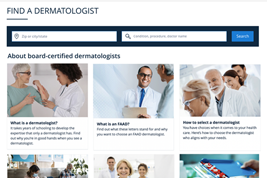 Find a Dermatologist
 Member directory
 AAD Learning Center
 2027 AAD Annual Meeting
 Need coding help?
 2027 Coding Resources
 Clinical guidelines
 Why use AAD measures?
 Latest news
 New insights
 Physician wellness
 Joining or selling a practice?
 Promote the specialty
 Advocacy priorities
