Varicella-zoster virus (VZV) is a DNA herpesvirus in which primary infection produces varicella (chickenpox).
After primary infection, the virus establishes latency in sensory ganglia, with later reactivation producing herpes zoster (“shingles”).
Epidemiology
Before widespread vaccination in the 1990s in the United States, VZV caused over 4 million cases per year, with 10,500–13,500 hospitalizations and 100–150 deaths annually, predominantly in children. (1)
High-risk groups for severe VZV include immunocompromised individuals without acquired immunity, pregnant women without acquired immunity, newborns whose mothers develop varicella from 5 days before to 2 days after delivery, and premature infants exposed to VZV or herpes zoster.(2)
Transmission and incubation
VZV is highly contagious, with transmissibility greater than mumps and rubella but lower than measles. Patients are contagious from 1–2 days before rash onset until all lesions have crusted.
Household attack rates approach 90% in susceptible contacts, while herpes zoster is significantly less contagious than primary varicella. (3)
Breakthrough varicella in single-dose vaccine recipients is approximately one-third as contagious if there are <50 lesions but more contagious when there are greater than or equal to 50 lesions. (4)
Clinical features in unvaccinated patients
Figure 1. “Dewdrop” vesicles on a “rose petal” erythematous base. Source: AAD.
The exanthem is generalized and intensely pruritic, with rapid evolution of individual erythematous macules to papules to clear vesicles (“dew drops on a rose petal”) and then to crusted papulonodules. The initial macules and papulovesicles characteristically appear in successive “crops” at different stages of development.
The distribution is centripetal, beginning on the trunk (particularly chest and back) and face, and then spreading to the extremities.
In adults, a mild prodrome of low-grade fever and malaise may precede the eruption by 1–2 days, while in children, the rash may be the initial presentation. (5)
In healthy children, the eruption typically lasts 4–7 days, with up to several hundred lesions, malaise, and fever less than or equal to 102°F for 2–3 days.
Disease tends to be more severe and extensive in infants, adults, pregnant patients, and immunocompromised hosts, often with more numerous lesions, higher fever, and prolonged course. Recovery from primary varicella usually results in lifelong immunity to reinfection, recurrent primary varicella is rare outside of significantly immunocompromised patients.
Figure 2. Multiple tense vesicles and pustules, some with umbilication, on an erythematous to hyperpigmented base. Source: AAD.
Clinical features in vaccinated patients (breakthrough varicella)
Breakthrough varicella is defined as infection with wild-type VZV occurring more than 42 days after vaccination. (5)
The clinical picture is generally mild, often afebrile or with only low-grade fever, and typically involving less than or equal to 50 lesions.
Lesions in breakthrough disease are frequently more maculopapular than vesicular and may never fully form classic clear vesicles.
The eruption is of shorter duration than in unvaccinated patients and may be sparse or localized, making clinical diagnosis challenging.
Figure 3. Clustered erythematous papulovesicles on the posterior neck with surrounding mild erythema. Source: AAD.Figure 4. Individual erythematous and crusted vesicles in a generalized distribution. Source: AAD.
Complications and cutaneous sequelae
Common complications
In healthy children, the most frequent complications are secondary bacterial skin and soft tissue infections, often arising from excoriated lesions and presenting as impetigo (or impetiginization), abscesses, and cellulitis.
Viral pneumonia is an important pulmonary complication, particularly in adults, and can present with dyspnea, hypoxemia, and diffuse interstitial infiltrates.
Severe and high-risk complications
Disseminated primary varicella with widespread cutaneous and visceral involvement is a major concern in immunocompromised individuals and adults.
Neurologic complications include cerebellar ataxia, encephalitis, Reye syndrome, and Guillain–Barré syndrome. (6)
Hepatitis is a rare but potentially fatal complication, most often affecting immunocompromised adults. (7)
Hematologic complications include thrombocytopenia and associated purpura.
Pregnancy-related disease and fetal effects
Maternal varicella during pregnancy increases the risk for severe pneumonia, premature labor, and rarely maternal death. (8)
Perinatal varicella, which is maternal rash that develops shortly before delivery or within 28 days postpartum, can result in severe fetal varicella infection with mortality rates up to 30% in neonates.
Congenital varicella syndrome, associated with maternal infection in the first 20 weeks of gestation (highest risk during 13–20 weeks), occurs in up to 2% of fetuses exposed to varicella and presents with a TORCH-like pattern of anomalies, including limb hypoplasia, cicatricial cutaneous scarring in dermatomal or stellate patterns, microcephaly, cortical atrophy, chorioretinitis, cataracts, and significant neurodevelopmental impairment. (9)
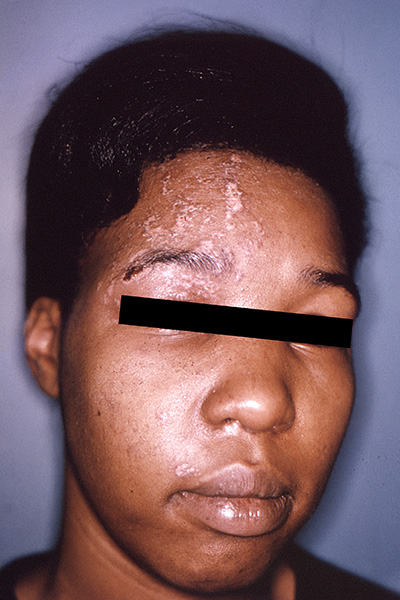
Figure 5. A patient with pustulovesicles in a V1 dermatomal distribution accompanied by periorbital edema. Source: CDC. (11)
Following primary infection, VZV remains latent in cranial nerves and dorsal root ganglia and may reactivate as herpes zoster.
Herpes zoster produces grouped vesicular lesions clustered on an erythematous base, typically in a single unilateral dermatome.
The dermatomal eruption is often intensely painful and pruritic, with pain typically preceding the rash by 1–3 days and sometimes persisting for week or months after cutaneous resolutions.
Post-herpetic neuralgia represents chronic neuropathic pain in the affected dermatome lasting months or longer, frequently described as burning, throbbing, or allodynic with extreme pain induced by light touch. (10)
Other reactivation complications include VZV vasculopathy (ischemic or hemorrhagic stroke, arterial thrombosis), myelopathy, acute retinal necrosis, cerebellitis, and zoster sine herpete (radicular pain without visible lesions).
Testing and diagnosis
In typical primary varicella, the diagnosis is clinically made.
PCR testing is the most accurate method to detect VZV DNA rapidly and sensitively from lesional swabs. (12)
Serologic testing (IgM and IgG) may assist in determining immunity status in pregnant women.
Patient management
Antiviral therapy
Primary varicella
In immunocompetent patients older than 12 years, early initiation of oral acyclovir can modestly shorten the duration and severity of fever and cutaneous disease.
In immunocompromised patients or those with severe primary varicella, IV acyclovir is indicated to reduce viral replication and risk of disseminated complications. (12)
Herpes zoster
Acyclovir, valacyclovir, and famciclovir are FDA-approved for the treatment of herpes-zoster.
Symptomatic care
In healthcare or congregate settings, airborne and contact precautions are indicated until all lesions have crusted. Therefore, care should be provided by varicella-immune staff preferentially, ideally in negative airflow rooms when available.
For healthy patients, supportive care includes discouraging scratching, using warm baths with soothing emollients or calamine lotion, and administering oral antihistamines to reduce pruritus.
Regarding antipyretic therapy, acetaminophen is generally preferred as some studies have associated NSAID use with possible severe skin infections, and the use of aspirin in children is a risk factor for Reye syndrome. (12)
Vaccination and post-exposure prophylaxis
Figure 6. Grouped hemorrhagic vesicles on an erythematous base in a dermatomal distribution. Source: AAD.
Children should receive two doses of VZV vaccine: the first at 12–15 months and the second at 4–6 years.
Vaccination is recommended for selected persons living with HIV (PLWH), certain other immunocompromised patients, household contacts of immunocompromised persons, postpartum and breastfeeding mothers, and healthcare personnel.
Varicella-zoster immune globulin should be administered within 96 hours of exposure to high-risk individuals without evidence of immunity, including pregnant women, severely immunocompromised patients, and newborns exposed in the perinatal window.
High-risk individuals exposed to VZV should avoid further contact, monitor closely for early signs of illness, and seek prompt medical evaluation. (13)
References
Clinical Overview of Chickenpox (Varicella): CDC; [updated 07/15/2024. Available from: https://www.cdc.gov/chickenpox/hcp/clinical-overview/index.html#cdc_clinical_overview_disease_rates-disease-rates.
Clinical Guidance for People at Risk for Severe Varicella: CDC; [updated 04/24/2024. Available from: https://www.cdc.gov/chickenpox/hcp/clinical-guidance/index.html.
Seiler HE. A study of herpes zoster particularly in its relationship to chickenpox. J Hyg (Lond). 1949;47(3):253–62.
Seward JF, Zhang JX, Maupin TJ, Mascola L, Jumaan AO. Contagiousness of varicella in vaccinated cases: a household contact study. JAMA. 2004;292(6):704–8.
Clinical Features of Chickenpox (Varicella): CDC; [updated 06/05/2024. Available from: https://www.cdc.gov/chickenpox/hcp/clinical-signs/index.html.
Nagel MA, Gilden D. Neurological complications of varicella zoster virus reactivation. Curr Opin Neurol. 2014;27(3):356–60.
Feldman HT, Neale M, Batra A, Mangano M, Newstein MC. A rare case of acute liver failure due to disseminated Varicella-Zoster Virus (VZV) infection. IDCases. 2025;40:e02224.