Rubella virus is an enveloped, positive-stranded RNA virus classified as a Rubivirus in the Matonaviridae family.
Epidemiology and transmission
In 1969, the rubella vaccine was licensed in the United States; by 2004, rubella was declared eliminated in the U.S. Since then, incidence has decreased by >99%, with fewer than 10 annual import-related cases. (1)
Still, approximately 100,000 infants are born with congenital rubella syndrome globally per year. (1)
Transmission occurs primarily via direct or droplet contact from nasopharyngeal secretions, with humans as the only natural hosts. (1)
The incubation period ranges 12–23 days, averaging 17 days post-exposure.
Clinical features
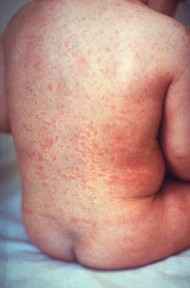
Figure 2. This image depicts a child’s torso, revealing coalescent morbilliform papules due to a case of rubella. Source: CDC. (4)
In ~50% of cases, rubella presents as mild or asymptomatic illness. (2)
Prodromal symptoms include mild subjective fever, sore throat, rhinorrhea, and malaise, and these occur more commonly in adults than children. (2)
Lymphadenopathy presents as tender, swollen retroauricular, posterior occipital, and posterior cervical nodes, classically preceding the rash and persisting for 5–8 days.
During the prodrome, Forchheimer sign manifests as pinpoint or larger petechiae on the soft palate and uvula.
Rash begins as a morbilliform eruption of pink or light red 2–3-mm thin papules on the face, rapidly generalizing to coalescent patches and thin plaques on the neck, trunk, and extremities within 24 hours. (2)
The rash is generally less widespread than measles and lasts an average of 3 days (up to 5).
Arthralgia or arthritis — manifesting as painful, swollen joints — is common in adults with rubella infection and may affect up to 70% of adult women. (1) The arthritis can persist longer than 2 weeks and may rarely become chronic. (2)
Rarely, there are reports of rubella-associated granulomatous dermatitis, typically in patients with inborn errors of immunity. This is an emerging, relatively newly described entity, and research is ongoing.
Figure 1. This infant presented with classic “blueberry muffin” papulonodules seen in congenital rubella. These lesions are cutaneous sites of extramedullary hematopoiesis and can occur in several congenital viral infections and hematologic diseases.Figure 3. The lower legs of this patient show signs of post-rubella arthritis with swelling of the ankle joints caused by an inflammatory arthritis-like syndrome. Source: CDC. (5)
Complications of rubella infection
Rare complications include thrombocytopenic purpura and encephalitis.
Rubella is a TORCH infection carrying less than or equal to 90% risk of fetal infection if a mother is infected during the first trimester. Features of congenital rubella syndrome include sensorineural hearing loss, cataracts, glaucoma, pigmentary retinopathy, patent ductus arteriosus, intellectual disability, meningoencephalitis, jaundice from hepatitis, diabetes mellitus, and thyroid dysfunction. (6)
Cutaneous congenital rubella syndrome presents as blueberry muffin syndrome, which includes disseminated blue to purple macules, papules, and nodules from dermal erythropoiesis.
Figure 4. The right eye of a 3-year-old infant, depicting a large bulging, cloudy cornea which is a typical finding of glaucoma due to congenital rubella infection. Source: CDC. (7)
Testing and diagnosis
Clinical diagnosis proves unreliable in up to 50% of subclinical cases given the nonspecific morbilliform eruption. (3)
Suspect rubella in unvaccinated patients with febrile morbilliform rash if they have had recent international travel or confirmed case exposure.
Confirm with nasopharyngeal / throat swabs or urine for PCR and molecular typing, as well as blood serology.
Immediately isolate and report suspected cases to local health department.
Patient management
No specific antiviral therapy exists for rubella.
Isolate patients for 7 days after rash onset. (3)
In pregnancy-exposure, initiate outbreak controls without awaiting laboratory confirmation.
Prevention
Administer two MMR doses to children: first at 12–15 months and second at 4–6 years.
Adults and teens who are at higher risk (healthcare workers, travelers) require 1–2 doses with presumptive immunity.
All people of childbearing age should be vaccinated or have other evidence of rubella immunity.
Avoid MMR if pregnant or attempting to become pregnant, and as a precaution, delay conception for 28 days post-vaccination. (8)
MMR vaccination after exposure does not reliably prevent infection but may provide protection against future exposures.
References
Clinical Overview of Rubella: CDC; [updated 07/15/2024. Available from: https://www.cdc.gov/rubella/hcp/clinical-overview/index.html.
Reef SE, Strebel P, Dabbagh A, Gacic-Dobo M, Cochi S. Progress toward control of rubella and prevention of congenital rubella syndrome--worldwide, 2009. J Infect Dis. 2011;204 Suppl 1(suppl_1):S24–7.
Glaucoma due to congenital rubella infection: CDC; 1969 [Available from: https://wwwn.cdc.gov/phil/Details.aspx?pid=17618.
Rubella Vaccine Recommendations: CDC; [updated 01/17/2025. Available from: https://www.cdc.gov/rubella/hcp/vaccine-considerations/index.html.
Advertisement
Advertisement
Advertisement
Registration begins today at 12 pm noon (CT) for physician members, life members, and honorary members.