Human papillomavirus comprises a family of more than 200 non-enveloped DNA viruses that selectively infect cutaneous and mucosal keratinocytes. (1)
Low-risk HPV types (6, 11) cause benign anogenital warts and papillomas, while high-risk oncogenic types (16, 18) are responsible for up to 70% of anogenital / oropharyngeal precancers and squamous cell carcinomas (SCCs).
The most common HPV types infecting the skin are 1, 2, 3, 4, 10, 27, 29, and 57.
Epidemiology and transmission
Mucosal epithelial HPV is transmitted person-to-person via skin-to-skin surface contact during vaginal, anal, or oral intercourse.
Vertical peripartum transmission may cause juvenile-onset respiratory papillomatosis or anogenital lesions in infants. (1)
Cutaneous HPV is transmitted by skin-to-skin contact or autoinoculation with microabrasions facilitating viral entry.
Approximately 39,500 HPV-attributable cancers occur annually in the United States. (2)
Lifetime acquisition risk approaches 85% in the U.S., establishing HPV as the most prevalent sexually transmitted infection, though most infections remain subclinical and self-resolve.
Risk factors include early sexual debut, multiple partners, tobacco use, immunosuppression, and HIV coinfection.
Common warts (verrucae vulgaris) present as firm, dome-shaped, cauliflower-like hyperkeratotic papules (3–10 mm) on hands, knees, or elbows, displaying disrupted skin lines and black puncta from thrombosed dermal papillae capillaries visible on paring.
Plantar warts (verrucae plantaris) (HPV-1, -2, -4) produce endophytic verrucous plaques on weight-bearing soles with mosaic patterns in clustered lesions.
Flat warts (verrucae plana) (HPV-3, -10) emerge as monomorphic 1–5-mm skin-colored or pink, flat-topped papules on the face, dorsal hands, or shins, often from autoinoculation spread by shaving.
Periungual warts present as friable hyperkeratotic plaques causing nail dystrophy, subungual debris, and paronychia-like inflammation.
Epidermodysplasia verruciformis (HPV-5, -8) in immunosuppressed patients, especially those with HIV, appears as disseminated red-brown flat-topped scaly papules resembling pityriasis versicolor on sun-exposed areas.
Figure 1. Periungual wart with fissuring, subungual debris, inflammation, and nail plate dystrophy. Source: AAD.Figure 2. Plantar warts, seen as hyperkeratotic plaques on weight-bearing sites of the soles. Source: AAD.
Clinical features: Benign low-risk HPV
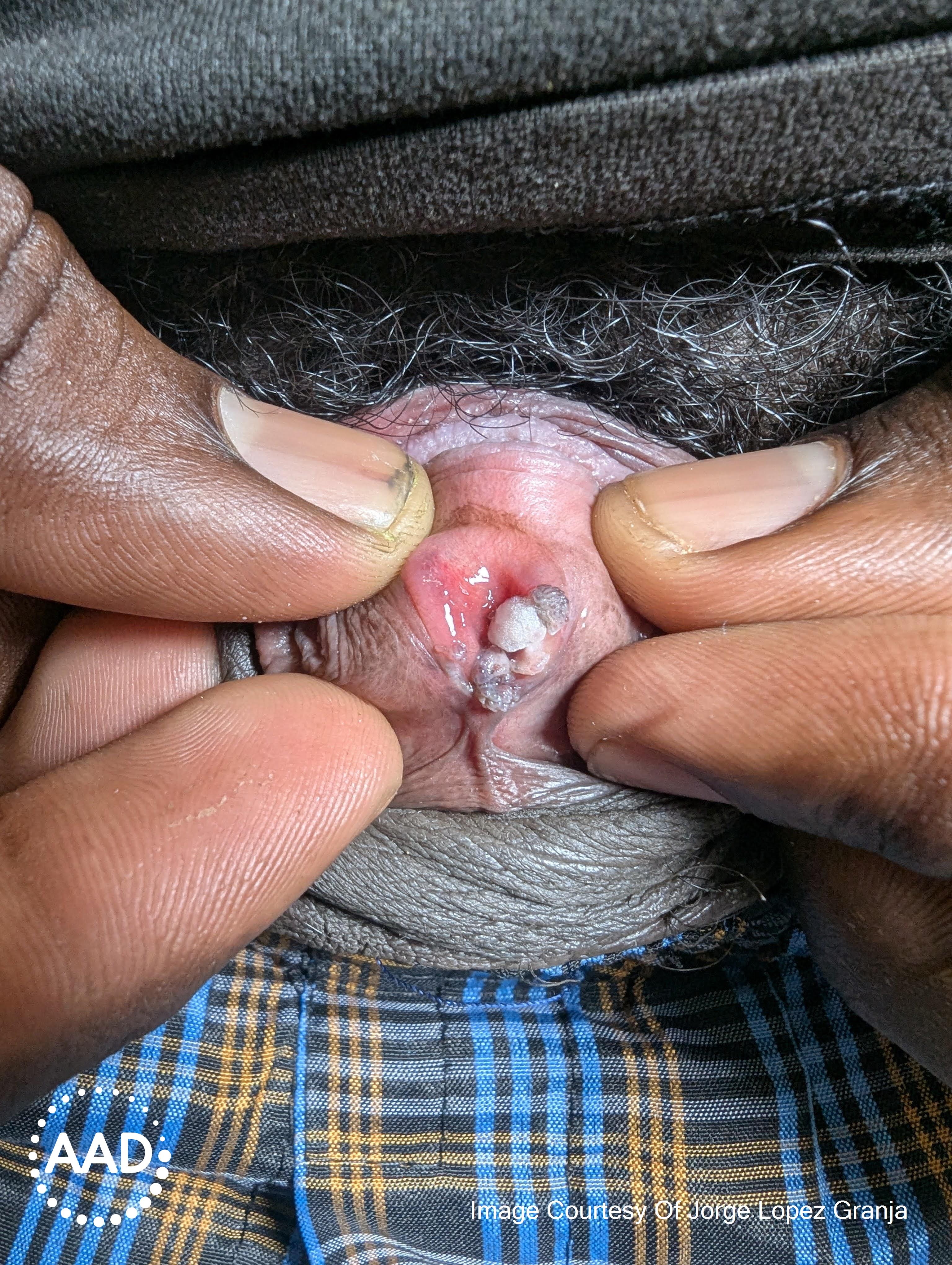
Low-risk HPV produces exophytic anogenital warts that present as multiple flesh-colored to pink papulonodules coalescing into verrucous plaques on the penile shaft, vulva, perianal skin, or oral mucosa. (1)
Squamous papillomas appear as soft, pedunculated masses on vocal cords, larynx, or the tracheobronchial tree, causing hoarseness or stridor. (4)
Conjunctival/oral papillomas present as sessile filiform papules on eyelids or buccal mucosa.
Vulvar intraepithelial neoplasia (VIN) (multiple well-demarcated hyperkeratotic or erythematous plaques on labia).
Penile intraepithelial neoplasia (PIN) (also known as erythroplasia of Queyrat) (red patches or plaques on the glans or inner foreskin with a velvety, moist, scaly, eroded, or warty surface).
Invasive anogenital SCC presents as indurated ulcerative or verrucous plaques with rolled borders, displaying keratin horns, surface erosion, and palpable induration on penile, vulvar, vaginal, or anal skin. (6)
Oropharyngeal HPV-related carcinomas manifest as firm ulcerative base-of-tongue masses or tonsillar asymmetry with cervical lymphadenopathy.
Bowenoid papulosis (HPV-16) manifests as solitary or multiple violaceous or hyperpigmented flat-topped papules (2–10 mm) on the penile shaft or vulva. It is usually asymptomatic but can become inflamed, pruritic, or painful. (7)
Figure 4. Verrucous, flesh-colored papules in the groin. Source: AAD.
Complications and sequelae
Cutaneous HPV infections have a variety of psychosocial effects and may interfere with activities of daily living, especially with acral and periungual lesions. (3)
Premalignant SILs may progress to SCC of the anus and rectum, oropharyngeal tract, cervix, vagina, vulva, and penis. (9)
Diagnosis and testing
Clinical diagnosis of cutaneous HPV lesions includes dermoscopy revealing dotted / linear vessels, thrombosed capillaries (black dots), and papillomatous (finger-like) surfaces.
Some lesions, such as verruca plana and genital lesions may not exhibit these dermoscopic findings. (10) Clinicians should maintain a high index of suspicion for lesions with clinical features concerning for verruca.
Anal / penile cytology can be employed to reveal koilocytes (perinuclear halos, abundant cytoplasm, hyperchromatic raisinoid nuclei). HPV DNA PCR typing distinguishes low-risk from high-risk genotypes.
Colposcopy or anoscopy and acetic acid test may reveal aceto-white lesions in the cervix / vagina or anal canal. Biopsy may be indicated for atypical, indurated, or therapy-resistant lesions.
Cutaneous HPV lesions are commonly treated with cryotherapy using application of liquid nitrogen. Other treatments for recurrent, resistant, or extensive warts include topical salicylic acid, imiquimod podophyllin, or sinecatechins and off-label use of topical 5-fluorouracil, bleomycin injections, topical or intralesional cidofovir, or electrosurgery. (11)
Anogenital warts, precancerous, and cancerous lesions can also be treated with cryotherapy or electrosurgery. (12)
High-grade SIL lesions require excision (LEEP, cone biopsy), ablation, or topical 5-fluorouracil imiquimod with treatment based on grade and disease extent.
Prevention
The two-dose 9-valent HPV vaccine (Gardasil 9) is recommended at ages 11–12 years (second dose should be administered 6–12 months following the initial dose). (13)
Vaccines prevent anogenital HPV and are anecdotally helpful in clearing extragenital HPV lesions. Vaccination is also recommended for individuals up to age 26 who may not have been fully vaccinated when younger.
Some adults age 27 through 45 years who are not already vaccinated may decide to get HPV vaccine after speaking with their doctor about their risk for new HPV infections and the possible benefits of vaccination for them. (14)
Cervical cytology (Pap smear) / HPV PCR co-testing is recommended every 3–5 years from age 30 for ongoing early screening for high-grade SIL.
Screening for anal cancer / high-grade SIL may be considered for high-risk populations, including men who have sex with men (MSM) and people living with HIV (PLWH), with either anal cytology (anal Pap test) +/- HPV testing or high-resolution anoscopy with biopsy. (15)
Anal cancer screening may reduce the burden of anal squamous cell carcinoma, as demonstrated in the Anal Cancer / HSIL Outcomes Research (ANCHOR) study.
Further evaluation can include referral to colorectal surgery to monitor for rectal involvement.
References
Sexually acquired human papillomavirus: DermNet; [Available from: https://dermnetnz.org/topics/sexually-acquired-human-papillomavirus.
Clinical Overview of HPV: CDC; [updated 07/09/2024. Available from: https://www.cdc.gov/hpv/hcp/clinical-overview/index.html.
Kreuter A, Brockmeyer NH, Hochdorfer B, Weissenborn SJ, Stucker M, Swoboda J, et al. Clinical spectrum and virologic characteristics of anal intraepithelial neoplasia in HIV infection. J Am Acad Dermatol. 2005;52(4):603–8.
D'Souza G, McNeel TS, Fakhry C. Understanding personal risk of oropharyngeal cancer: risk-groups for oncogenic oral HPV infection and oropharyngeal cancer. Ann Oncol. 2017;28(12):3065–9.
Al Rudaisat M, Cheng H. Dermoscopy Features of Cutaneous Warts. Int J Gen Med. 2021;14:9903–12.
Ringin SA. The Effectiveness of Cutaneous Wart Resolution with Current Treatment Modalities. J Cutan Aesthet Surg. 2020;13(1):24–30.
Barton S, Wakefield V, O'Mahony C, Edwards S. Effectiveness of topical and ablative therapies in treatment of anogenital warts: a systematic review and network meta-analysis. BMJ Open. 2019;9(10):e027765.
Markowitz LE, Schiller JT. Human Papillomavirus Vaccines. J Infect Dis. 2021;224(12 Suppl 2):S367–S78.
HPV Vaccination: CDC; [updated 08/20/2024. Available from: https://www.cdc.gov/hpv/vaccines/index.html.
Cohen CM, Clarke MA. Anal Cancer and Anal Cancer Screening. Clin Obstet Gynecol. 2023;66(3):516–33.
Advertisement
Advertisement
Advertisement
Registration begins today at 12 pm noon (CT) for physician members, life members, and honorary members.