






Skin cancer: Symptoms, diagnosis, and causes
Dermatologist reviewed: Nkanyezi Ferguson, MD, FAAD; Ata Moshiri, MD, MPH, FAAD. Reviewer bios.
What is skin cancer?
Skin cancer is cancer that begins on your skin. It’s the most common cancer in the United States. A common early sign is a spot on your skin that’s growing, bleeding, or changing. A board-certified dermatologist can tell you whether a spot is skin cancer or something else.
In this article:
Types of skin cancer
The three most common types of skin cancer are basal cell carcinoma, squamous cell carcinoma, and melanoma. There are also some less common types, such as Merkel cell carcinoma. With all types, it’s possible to find skin cancer early when it’s highly treatable.
To see pictures of the different types of skin cancer and tips for finding each type early, go to:
Want to know more about one type of skin cancer? Here you’ll find dermatologist-approved information on symptoms, diagnosis, treatment, and more:

What are the symptoms of skin cancer?
Skin cancer can appear on the skin in many ways. It can look like a:
Growing spot or bump that may bleed
Rough, scaly spot or patch
Firm, dome-shaped growth
Shiny bump
Sore that doesn't heal (or heals and returns in the same spot)
An insect bite or pimple but doesn’t go away
Mole that shows any of the ABCDEs of melanoma

What does skin cancer look like at the start?
An early skin cancer often appears as a spot or growth that doesn’t go away. Since skin cancer begins on the skin, it’s possible to find it by learning the early warning signs.
When looking at your skin, pay close attention to moles. A type of skin cancer called melanoma can look like a mole, but with some differences. A spot might be melanoma if it looks asymmetrical (one half is unlike the other half), has a blurry or uneven border, contains two or more colors, is bigger than a pencil eraser (can be smaller), or is changing over time.
Bottomline: If you find a spot or growth on your skin that’s growing, bleeding, or changing, see a board-certified dermatologist.
— Candace Thrash, MD, FAAD, board-certified dermatologist specializing in both medical and cosmetic dermatology
To see pictures of the most common types of skin cancer, go to:
What does skin cancer feel like?
For many people, the only sign of skin cancer is a new or changing spot or growth on their skin. Sometimes, this spot or growth:
Itches
Feels tender or painful
Causes some numbness
If you experience any of these symptoms, tell your dermatologist.
Where do you get skin cancer?
Skin cancer can develop anywhere on your skin. It often appears on skin that’s had lots of sun, such as your:
Head, including scalp
Neck
Hand
Arm
It can also develop on your back, chest, shoulder, abdomen, or leg. Sometimes, it appears in a place that may surprise you, such as under (or around) a fingernail or toenail. It can even appear on the lips, genitals, or the bottom of your foot.
Can you feel well and still have skin cancer?
Yes, you can feel well. Many people who have early skin cancer, such as a growing spot on their skin or dark streak beneath a nail, feel fine. They don’t have any pain. They don’t feel ill.
Skin exams
The purpose of a skin exam is to see if your skin shows any signs of skin cancer. Two types of skin exams are used to find these signs:
Skin self-exam (performed by you, your partner, or both)
Skin cancer exam (performed by a medical professional)
The following explains each of these skin exams.
Skin self-exam: How to check for signs of skin cancer
Because skin cancer begins on your skin, you can find this cancer early. Performing skin self-exams can help find skin cancer in its earliest and most treatable stage.
That’s why the American Academy of Dermatology recommends performing skin self-exams regularly.
To help you perform a skin self-exam, you’ll find a video that shows you how to perform this exam and step-by-step illustrations at:
Finding skin cancer: How to perform a skin self-exam
Performing skin self-exams can be lifesaving, as melanoma survivor Andy Jacobs knows. Andy almost missed melanoma on his leg, so he shares his skin cancer story to help others find skin cancer early. Discover the chance event that led to Andy’s melanoma diagnosis at:
Melanoma can be missed if you don’t check for skin cancer
Skin cancer exam: How dermatologists find signs of skin cancer
What your dermatologist looks at during a skin cancer exam varies. Here’s what to expect:
You found a spot on your skin that could be skin cancer: Your dermatologist will examine the spot and surrounding area carefully.
You make an appointment for a full-body skin exam: This is a head-to-toe examination. Your dermatologist will thoroughly examine your skin, scalp, and nails for signs of skin cancer.
If your dermatologist sees a spot that could be skin cancer, you’ll need a skin biopsy. During this procedure your dermatologist removes a small part of the spot and sends it to a lab where it will be examined under a microscope. This is the only way to diagnose skin cancer.
How often should you have a full-body skin exam?
This varies with your risk of developing skin cancer and whether you’ve previously had skin cancer. Your dermatologist can tell you how often you should return for a full-body skin exam.
Free skin cancer checks offered by American Academy of Dermatology (AAD)
Since 1985, the AAD has performed millions of free checks and detected hundreds of thousands of spots or growths that could be skin cancer.

The AAD offers free skin checks throughout the U.S.
Free checks are available across the United States. Find out more about this program and see if there is a free check near you, go to:
How is skin cancer diagnosed?
A procedure called a skin biopsy is required to diagnose skin cancer. A dermatologist is the doctor who usually performs this procedure.
Before performing a skin biopsy, your dermatologist will look closely at a spot that could be skin cancer. A skin biopsy is only necessary when your dermatologist sees any warning signs of skin cancer. Not every spot, mole, or growth needs to be biopsied. Dermatologists have the training and expertise needed to know when to biopsy and when not to.
If a spot on your skin requires a biopsy, your dermatologist will:
Numb the area
Remove some skin from the spot or growth
Send the removed skin to a laboratory
Your dermatologist can perform a skin biopsy during your in-office appointment.
At the laboratory, a doctor, such as a dermatologist or a dermatopathologist, will look at the removed skin under a microscope. Looking at it under a microscope is the only way to know for certain if you have skin cancer. If you have skin cancer, the doctor will also diagnose the type of skin cancer you have.

Can I use ChatGPT to find out if I have skin cancer?
No, you should not use ChatGPT or another AI chatbot like Gemini or Claude to find skin cancer. Research shows that AI chatbots can misdiagnose you.
Dermatologists and other researchers have been studying whether AI chatbots can distinguish between skin cancer and other growths. To do this, they showed known pictures of skin cancer and benign (not cancer) growths to the bots. There were mistakes.
While the AI bots are getting better at diagnosing these pictures, the accuracy needs to be better. Missing an early melanoma can be deadly. Diagnosing a non-cancerous growth as skin cancer can lead to unnecessary worry.
For now, if you’re wondering whether you have skin cancer, see the skin cancer expert, a board-certified dermatologist.
— Ivy Lee, MD, FAAD, is a board-certified dermatologist and digital health consultant who specializes in medical and cosmetic dermatology
Treatment
How is skin cancer treated?
If you are diagnosed with skin cancer, your dermatologist will determine the best treatment(s) for you by considering the type of skin cancer you have, how deeply the tumor has grown, your overall health, and much more.
Many skin cancers are treated with surgery to remove the cancer. When caught early, surgery can often be performed while you remain awake, and it’s often the only treatment needed.
Surgery is often performed using a local anesthetic to numb the area before treatment. The surgeries used to treat skin cancer are:
Excision: During this surgery, your dermatologist removes the skin cancer and a bit of normal-looking skin from around the cancer. A doctor, such as a dermatologist or dermatopathologist, will look at what your dermatologist removed, using a microscope. The doctor is looking for cancer cells in the normal-looking skin. If none are seen, treatment is complete. While uncommon, if the cancer is not completely removed, you’ll need another treatment.
Mohs surgery: This is a specialized surgery used only to treat skin cancer, especially in areas where you have little skin like an ear. It’s usually performed in a medical office under local anesthesia, so you remain awake. Mohs surgery begins with your Mohs surgeon removing the skin cancer and a bit of normal-looking skin below and around it. While you wait, the surgeon uses a microscope to look at what was removed. If the surgeon sees cancer cells, surgery continues until cancer cells are no longer seen.
Electrodessication and curettage: During this surgical procedure, your dermatologist removes the cancer by first scraping (curetting) the growth from the skin and then heating the treated area to destroy any remaining cancer cells.
For some patients, another treatment may be more appropriate than surgery. Sometimes, a patient needs surgery along with another treatment to treat the cancer. Other treatments for skin cancer include:
Radiation therapy: This therapy uses a series of radiation treatments to destroy cancer cells. Radiation may be recommended when a patient cannot have surgery to remove the cancer, when an aggressive cancer requires additional treatment after surgery, or when surgery may not be the best choice. The right skin care can reduce side effects to your skin. See what dermatologists recommend at:
How to care for your skin during and after radiation therapyCryosurgery: During this procedure, your dermatologist freezes the skin cancer so that it will fall off after a few days. Your dermatologist can perform cryosurgery during an office visit while you remain awake. After cryosurgery, you may see crusting or a blister on your skin that was treated. This is normal and expected. Some skin cancers require more than one cryosurgery treatment.
Photodynamic therapy: Some skin cancers on the top layers of skin can be destroyed with this procedure. Photodynamic therapy is a two-step process. It begins with a chemical being placed on the area with skin cancer. This chemical stays on your skin for a while, so it can be absorbed. The treated area is then exposed to a special light. This combination of a chemical and a special light can kill cancer cells.
Medication you apply at home: To treat the earliest form of skin cancer, your dermatologist may prescribe this type of medication. It works to destroy cancer cells.
Medication you take by mouth: This type of medication may be prescribed for patients who have advanced skin cancer. It may be prescribed to treat advanced cancer that has been treated with surgery, radiation, or both. It’s also prescribed to treat skin cancer that cannot be removed with surgery or treated with radiation.
Immunotherapy medication: This type of medication can stimulate your immune system to destroy cancer cells. For advanced skin cancer, it may be given by an intravenous (IV) infusion. Other medications that stimulate the immune system are injected directly into the skin cancer tumor. One medication is applied directly to skin cancer.
Are natural treatments effective for treating skin cancer?
No, dermatologists do not recommend that anyone treat skin cancer with a natural remedy. None have been proven to work.
Despite this, you’ll find plenty of these products on websites and social media platforms. These products often come with claims that they cure cancer. While these remedies may sound promising, natural remedies can be harmful.
Find out just how harmful these remedies, which include black drawing salve, can be at:
Natural treatment for skin cancer: Not as safe as you think
If I cannot afford skin cancer treatment, is financial help available?
Yes, some people are eligible for financial assistance. You’ll find information about who’s eligible and what types of financial assistance are available at:
Financial help for people who have skin cancer
Causes
What causes skin cancer?
Most skin cancers are caused by ultraviolet (UV) light from:
The sun
Indoor tanning
Every time you expose your skin to UV light, this light damages your skin. Your body can repair this damage. However, there comes a point when your body can no longer repair itself. That’s when skin cancer develops.
While you can see signs of UV damage on your skin, such as dark spots and wrinkles, it takes years for this damage to appear on the surface of your skin. Long before you see signs on your skin, you can have extensive damage beneath the surface. UV photography lets us see this damage.
Can you spot skin cancer?
A UV camera reveals the hidden sun damage that lies beneath people’s skin.
Other causes of skin cancer
Not all skin cancers develop on skin exposed to UV light. Sometimes, skin cancer develops in an area, such as the genitals, under a nail, or inside of the mouth. Research suggests that these cancers may be caused by a virus, changes inside your cells, or a weakened immune system. More research is needed to find the cause of skin cancers that don’t develop on skin exposed to UV light.
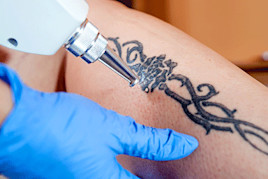
Tattoos and skin cancer: More research is needed to know whether tattoos and skin cancer are linked. Dermatologists say the greater risk is that a tattoo may disguise skin cancer, making it harder to detect. Find out how you can prevent a tattoo from hiding skin cancer at:
Who gets skin cancer?
Anyone can develop skin cancer, regardless of their skin tone. However, the people who are most likely to develop skin cancer have one or more of the following:
Light-colored skin
Skin that burns or freckles rather than tans
Blonde or red hair and light-colored eyes
50 moles or more
Moles that are irregularly shaped, known as “atypical” or “dysplastic” moles
While people with a light skin tone are much more likely to develop skin cancer, people with darker skin tones also develop this cancer. When people who have a darker skin tone develop skin cancer, they are often diagnosed in later stages. That’s when skin cancer is more difficult to treat.
The American Academy of Dermatology is committed to helping people who have darker skin tones find skin cancer earlier. The following explains what to look for:
Finding skin cancer in darker skin tones
The risk of developing skin cancer increases if you:
Seldom protected your skin from the sun
Had sunburns, especially blistering sunburns
Used indoor tanning, such as tanning beds or sunlamps
Are 50 years of age or older
Are an organ transplant recipient
Have had skin cancer or have blood relatives who had skin cancer
Had cancer as a child
Been exposed to cancer-causing compounds, such as arsenic or tar
Have a weakened immune system
Have skin that has been badly burned
Keep in mind that skin cancer is common. It’s estimated that every day about 9,500 people in the United States are diagnosed with this cancer. Most people are diagnosed with either basal cell carcinoma or squamous cell carcinoma. These types of skin cancer tend to grow more slowly, and most people have a good outcome.
Can you reduce your risk of developing skin cancer?
Effective ways to reduce your skin cancer risk are:
Protect your skin from the sun.
Do not use indoor tanning.
Doing both can greatly reduce your risk of developing skin cancer as well as signs of early skin aging.
Can blood pressure medication increase your risk of developing skin cancer?
A few studies have found a link between taking some blood pressure medications and an increased risk of developing skin cancer. Other studies have not found this to be true. To find out what the research shows, go to:
Can blood pressure medication increase your skin cancer risk?
Prevention
Is skin cancer preventable?
You can reduce your risk of getting skin cancer. Most skin cancers are caused by UV light, so protecting your skin from this light can reduce your risk. For this reason, the American Academy of Dermatology encourages everyone to:
Stay out of tanning beds.
Keep in mind that some people have a high risk of developing skin cancer, such as those who have had skin cancer, developed 50+ moles on their skin, or live with an organ transplant.
If you have a high risk, taking steps to protect your skin can reduce your risk of developing skin cancer. However, with a greatly increased risk, you may still develop skin cancer.
Are tanning beds safer than the sun?
Tanning beds are not safer than the sun. That’s a myth. Another myth is that getting a base tan will prevent sunburn. Research shows that neither is true. Here are 10 research-based facts about indoor tanning that can help you prevent skin cancer:
10 surprising facts about indoor tanning
American Academy of Dermatology (AAD) program helps children prevent skin cancer
Shade plays an important role in preventing skin cancer. That’s why the AAD provides grants to build permanent shade structures where children learn and play.

The AAD’s Shade Structure Grant Program provides shade for millions of children every day.
To learn more about this program and find out if a school, park, or another facility near you is eligible for a shade structure grant, go to:
Free videos and infographics
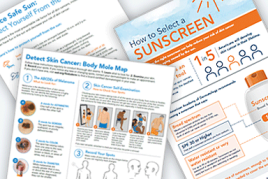
The American Academy of Dermatology is committed to helping people reduce their risk of developing skin cancer and finding it early when skin cancer is highly treatable. That’s why we offer free, dermatologist-approved videos and infographics. We invite you to view these free resources and share them — whether posting on social media, sending a link in a message to a friend or family member, or printing infographics to hand out at a community event. You’ll find these resources at:
Skin health: Free infographics and videos
Skin cancer: Key takeaways
Skin cancer is the most common cancer that people develop.
If you find a spot on your skin that is growing, bleeding, or changing, make an appointment to see the skin cancer expert, a board-certified dermatologist.
Found early and properly treated, skin cancer is highly treatable.
If you’ve been treated for skin cancer, you have a higher risk of developing another skin cancer. Checking your skin for skin cancer and keeping all your dermatology appointments can help you find skin cancer early when it’s most treatable.
You can reduce your risk of developing skin cancer by protecting your skin from the sun and never using indoor tanning.
Dermatologist reviewer bios
Nkanyezi Ferguson, MD, FAAD
A board-certified dermatologist and Mohs surgeon, Dr. Ferguson is well known for her expertise in:
Diagnosing and treating skin cancer
Performing advanced skin cancer surgeries
Providing individualized and culturally sensitive care for patients who have darker skin tones
Patients come to see her for her advanced surgical techniques, which can help to restore their appearance and function after surgery to remove difficult-to-treat skin cancers. She is also known for the specialized care that she provides patients with darker skin tones who see her for conditions that include keloids and hair loss.
Dr. Ferguson practices in Missouri at the University of Missouri, School of Medicine. There she is the Co-Medical Director of Dermatology Clinics, Director of Micrographic Dermatology Surgery, Associate Professor of Dermatology, and Fellowship Director for Micrographic Surgery and Dermatologic Oncology.
Ata Moshiri, MD, MPH, FAAD
Board certified in dermatology and dermatopathology, Dr. Moshiri is well known for his expertise in:
Treating melanoma and pigmented skin growths
Melanoma research, which has led to advancements in patient care
Using technology and scientific advances to improve his patients’ outcomes
Patients know him for his proactive approach, which emphasizes early detection and innovative treatment. As a dermatopathologist (a specialist who diagnoses skin conditions by studying what your dermatologist removed during a skin biopsy), Dr. Moshiri is known as the doctor to whom dermatologists send their most difficult-to-diagnose biopsies.
Dr. Moshiri sees patients in New York City at NYU Langone Health, where he is Associate Professor in the Department of Dermatology, Director of Dermatopathology Laboratory Operations, and Program Director of the Dermatology and Dermatopathology Fellowship Program.
Written by Paula Ludmann, MS
Paula has more than 20 years of experience writing about skin, hair, and nail conditions for patients and the public.
She enjoys developing easy-to-understand information that people can use to make informed health decisions.
Paula’s passion for creating patient-first information has led to her work being mentioned by Prevention magazine and the Washington Post. She has won numerous awards, including Webbies, Apex Awards, and several awards from professional organizations.
References
American Cancer Society. Cancer Facts & Figures 2026. Atlanta: American Cancer Society; 2026.
American Academy of Dermatology. “Indoor tanning fact sheet.” Last updated Feb. 11, 2025. Last accessed Jul 17, 2026.
Anadolu-Brasie R, Patel AR, et al. “Squamous cell carcinoma of the skin.” In Nouri K et al. Skin Cancer. McGraw Hill Medical, China, 2008:86-110.
Cameron MC, Lee E, et al.” Basal cell carcinoma: Epidemiology; pathophysiology; clinical and histological subtypes; and disease associations.” J Am Acad Dermatol. 2019 Feb;80(2):303-17.
Ghajar-Rahimi G, Yusuf N. “Updates in clinical trial-explored chemopreventive agents for cutaneous melanoma: Mechanisms affecting melanocytes.” Melanoma Manag. 2025 May 13;12(1):2505400.
Halpern M, Chen E, et al. “Sarcomas.” In Nouri K. [editor]. Skin Cancer. United States. McGraw Hill Medical; 2008. p. 217-8.
Hassel JC, Enk AH. “Melanoma.” In: Kang S, Amagai M, et al. Fitzpatrick’s Dermatology (ninth edition). McGraw Hill Education, New York, 2019:1982-92.
Martinelli PT, Cohen PR, et al. “Sebaceous carcinoma.” In Nouri K. [editor]. Skin Cancer. United States. McGraw Hill Medical; 2008. p. 240-9.
McEvoy A, Nghiem P. “Merkel cell carcinoma.” In: Kang S, Amagai M, et al. Fitzpatrick’s Dermatology (ninth edition). McGraw Hill Education, New York, 2019:1920-1.
Nouri K, Ballard CJ, et al. “Basal cell carcinoma.” In: Nouri K, et al. Skin Cancer. McGraw Hill Medical, China, 2008: 61-81.
Nouri K, Patel SS, et al. “Etiology of skin cancer.” In: Nouri K, et al. Skin Cancer. McGraw Hill Medical, China, 2008:39.
Sattler SS, Chetla N, et al. “Evaluating the diagnostic accuracy of ChatGPT-4 Omni and ChatGPT-4 Turbo in identifying melanoma: Comparative study.” JMIR Dermatol 2025;8:e67551
Shifai N, van Doorn R, et al. “Can ChatGPT vision diagnose melanoma? An exploratory diagnostic accuracy study.” J Am Acad Dermatol. 2024 May;90(5):1057-9.
Trager MH, Queen D, et al. “Advances in prevention and surveillance of cutaneous malignancies.” Am J Med. 2020 Apr;133(4):417-23.
U.S. Food and Drug Administration. “Products claiming to “cure” cancer are a cruel deception.” Content current as of: Sept. 4, 2020. Last accessed Jul 17, 2026.
Image credits
Image 1: Courtesy of Candace Thrash, MD, FAAD
Images 2, 4, 5: American Academy of Dermatology
Image 3: Courtesy of Ivy Lee, MD, FAAD