





10 surprising facts about indoor tanning
Last updated: July 30, 2026
Dermatologist reviewed: Laurel Geraghty, MD, FAAD; Morgan BriAnne Murphrey, MD, MS, FAAD; Sanna Ronkainen, MD, FAAD. Reviewer bios.
Is a tanning bed safer than the sun? Will indoor tanning help your body make all the vitamin D it needs? Findings from years of scientific studies have answered these and other burning questions about indoor tanning.
Here are 10 research-backed facts that may surprise you.
Tanning beds are NOT safer than the sun. Science tells us that there’s no such thing as a safe tanning bed, tanning booth, or sun lamp.
Indoor tanning can more than double your risk of developing melanoma.(1) Indoor tanning can also increase the risk of developing the two most common types of skin cancer — squamous cell carcinoma by 58% and basal cell carcinoma by 24%.(2)
Indoor tanning and cancer risk
Indoor tanning can more than double your risk of developing melanoma.(1)
The evidence that indoor tanning dramatically increases your risk of getting skin cancer is so strong that:
- The U.S. Food and Drug Administration (FDA) requires warning labels on all indoor tanning equipment.
- Australia, Brazil, and Iran have passed legislation that makes it illegal to sell indoor tanning sessions. Because businesses cannot make money, you won’t find these services offered in those countries.(3) Many other countries have age restrictions for indoor tanning.(3)
- The U.S. Department of Health and Human Services and the World Health Organization classify ultraviolet (UV) rays from the sun and artificial sources, such as tanning beds and sun lamps, as carcinogens (known to cause cancer).(4)
Tanning — indoors or with the sun — ages your skin more quickly. Wrinkles, age spots, and loss of skin firmness tend to appear years earlier in people who tan. If you tan, you can also develop leathery skin. People who never tan don’t develop leathery skin.
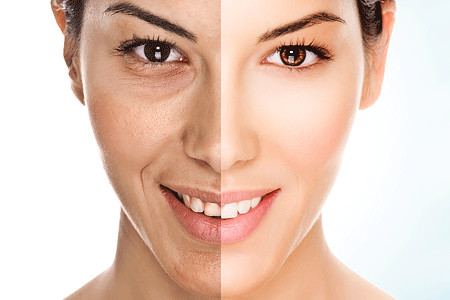
Indoor tanning (left side) dramatically speeds up how quickly your skin ages.
Using tanning beds can cause serious injury. In emergency rooms across the United States, people are treated for burns, loss of consciousness, and eye injuries caused by indoor tanning.
Getting a base tan cannot prevent sunburn. Many people believe that using a tanning bed to get a base tan will prevent sunburn. This is an absolute myth. If you have a base tan, you can still sunburn.
Keep in mind, every time you tan or sunburn, you damage the DNA in your skin. The more you damage your DNA, the greater your risk of getting skin cancer. Research shows that experiencing 5 or more blistering sunburns between the ages of 15-20 increases melanoma risk by 80%.(5)
Getting enough vitamin D from tanning beds isn’t possible. You may have heard that your body makes a lot of vitamin D when you use a tanning bed, but the truth is it doesn’t. The bulbs used in tanning beds emit mostly UVA light; however, your body needs UVB light to make vitamin D.
To get vitamin D safely, board-certified dermatologists recommend that healthy adults obtain vitamin D from their diet. Good sources include foods naturally rich in vitamin D, such as salmon and egg yolks, as well as foods and beverages fortified with vitamin D.
Becoming addicted to tanning is a real risk. Evidence indicates that tanning can be addictive. Some people find it hard to stop tanning. When they don’t get a steady dose of UV rays, they can feel restless or depressed.
Tanning (indoors or outside) can make several skin conditions, including stretch marks, more noticeable. You can camouflage stretch marks safely by using self-tanner.
By not tanning, you also make several skin conditions, including dark spots from acne, scars, melasma, and a fungal skin infection called tinea versicolor, less noticeable.
Giving customers “false and misleading information” has been a common practice at tanning salons. A study run by the U.S. House of Representatives made a startling discovery.
During this study, staff at tanning salons were asked questions about the risks of indoor tanning. Investigators found that 90% of staff at tanning salons said indoor tanning is not a health risk for a fair-skinned teenage girl.(6) Many staff at tanning salons even said that tanning has health benefits.(7)
This led the U.S. House of Representatives to report that “the vast majority of tanning salons contacted by Committee investigators provided false information about the serious risks of indoor tanning and made specious claims about the health benefits that indoor tanning provides.”(8)

Looking tan year-round is possible with a self-tanner. A self-tanner offers you a way to look tan without increasing your risk of developing early wrinkles, leathery skin, and skin cancer.
Applied the right way, self-tanners look natural — and won’t give you orange skin, streaks, or splotches.
How to apply self-tanner
Keep in mind that when you use a self-tanner, it’s important to wear sunscreen that offers broad-spectrum protection, SPF 30 or higher, and water resistance. A self-tanner cannot protect your skin from the sun.
Quitting (or never starting) indoor tanning can help you live longer. By choosing not to tan, you reduce your risk of getting many types of skin cancer, including melanoma. You also reduce your risk of developing pre-cancerous skin growths called actinic keratoses (AKs).

It’s never too late to start protecting your skin from the sun and indoor tanning. As soon as you do, your body starts to repair some of the damage caused by the UV rays.
Related AAD resources
Skin cancer: Learn about symptoms, how skin cancer is diagnosed, and the causes.
Dermatologist reviewer bios
Laurel Naversen Geraghty, MD, FAAD
Board certified in dermatology, Dr. Geraghty is known for her expertise and research in the following areas:
Melanoma
Skin conditions that occur during pregnancy
Using lasers to treat scars, wrinkles, and other skin concerns
Before becoming a doctor, Dr. Geraghty worked as a writer and editor, which included a position as a Senior Editor at Glamour magazine. Today, she uses her communication skills to clearly explain information to her patients. Patients appreciate her clear explanations, thoroughness during skin checks, and the natural-looking results they see after a cosmetic treatment.
Dr. Geraghty sees patients at a dermatology clinic in southern Oregon, where she treats skin conditions and performs cosmetic procedures. Due to her expertise in these areas, national media often contact her for quotes.
Morgan BriAnne Murphrey, MD, MS, FAAD
Board certified in dermatology, Dr. Murphrey is known for her expertise and research in:
Laser surgery
New therapies that can prevent and treat skin cancer
Cutting-edge treatments for skin, hair, and nails
Her research focuses on finding innovative solutions to problems that patients face.
Dr. Murphrey sees patients at a dermatology clinic in Boston, where she cares for skin, hair, and nail conditions and provides cosmetic treatments. She teaches part-time at Harvard Medical School and conducts her research at the Wellman Center for Photomedicine of Massachusetts General Hospital.
Sanna Ronkainen, MD, FAAD
Board certified in dermatology and internal medicine, Dr. Ronkainen is well known for her expertise in diagnosing and treating the following conditions:
Cutaneous lymphoma (type of cancer that affects the skin)
Lupus, sarcoidosis, and complex rashes
Skin-related side effects caused by cancer treatment
Her patients appreciate that she takes the time to answer questions and makes them feel comfortable discussing sensitive issues. She has a special interest in cutaneous lymphoma and helped launch a clinic dedicated to this condition. To help patients when a disease like HIV or cancer affects their skin, Dr. Ronkainen collaborates with doctors in other specialties.
Practicing in the Washington DC area, Dr. Ronkainen says, “There’s nothing better than seeing patients after a few months and hearing how happy they are with the improvement in their skin condition.”
Written by Paula Ludmann, MS
Paula has more than 20 years of experience writing about skin, hair, and nail conditions for patients and the public.
She enjoys developing easy-to-understand information that people can use to make informed health decisions.
Paula’s passion for creating patient-first information has led to her work being mentioned by Prevention magazine and the Washington Post. She has won numerous awards, including Webbies, Apex Awards, and several awards from professional organizations.
References
American Academy of Dermatology
1, 2, 4. Indoor tanning fact sheet. Last updated Feb 11, 2025. Last accessed Jul 16, 2026.
3. New survey reveals public confusion about risks of indoor tanning and sunburns. News release May 24, 2022. Last accessed Jul 16, 2026.
5. Melanoma fact sheet. Last updated Mar 2, 2026. Last accessed Jul 16,2026
Banerjee SC, Hay JL, et al. “Quitting the ‘cancer tube’: A qualitative examination of the process of indoor tanning cessation.” Transl Behav Med. 2014; 4(2): 209-19.
Coups EJ, Stapleton JL, et al. “Frequent indoor tanning among New Jersey high school students.” J Am Acad Dermatol. 2015; 72(5): 914-16.
Ernst A, Grimm A, et al. “Tanning lamps: Health effects and reclassification.” J Am Acad Dermatol 2015;72:175-80.
Gordon LG, Sinclair C, et al. “Consequences of banning commercial solaria in 2016 in Australia.” Health Policy. 2020 Jun;124(6):665-70.
Guy GP Jr, Berkowitz Z, et al. “Indoor tanning among high school students in the United States, 2009 and 2011.” JAMA Dermatol. 2014; 150(5):501-11.
Lim HW, MD, Collins SAB, et al. “The burden of skin disease in the United States.” J Am Acad Dermatol 2017;76:958-72.
Stier MF and Hirsch RJ. “Rejuvenation of scars and striae.” In: Hirsch RJ, et al. Aesthetic rejuvenation. McGraw Hill Medical, China, 2009:224-9.
6, 7, 8. U.S. House of Representatives Committee on Energy and Commerce. “False and misleading health information provided to teens by the indoor tanning industry.” Published February 1, 2012. Last accessed May 6, 2026.
Image credit
Getty Images