





Natural treatments for skin cancer not as safe as you think
Dermatologist reviewed: Shari Lipner, MD, PhD, FAAD; Michael O’Donoghue, MD, FAAD; Temitayo Ogunleye, MD, FAAD. Reviewer bios.
If you’ve been diagnosed with skin cancer, natural treatment may sound like a safe and healthy option. Before you use any natural treatment — from cure-all salves to vitamins and herbs meant to strengthen your immune system — here are 7 evidence-backed facts you need to know.
No natural product has been proven to cure skin cancer.
When looking for natural skin cancer products, you may see claims, such as “can cure you,” “shrinks tumors,” or “kills only cancer cells.” None of the claims on these products have been proven. None of these products have been approved by the U.S. Food and Drug Administration (FDA) to treat cancer.
4 warning signs of an unsafe skin cancer treatment
When looking at product information about a natural treatment for skin cancer, you may see one or more of the following warning signs:
Cures cancer without surgery or a biopsy
“Secret” (or proprietary) formula
Testimonials, but no data from a clinical trial
Advice to avoid doctors
To help consumers steer clear of potentially unsafe and unproven treatments, the FDA provides information to help you spot fraudulent products on this webpage, “6 tip-offs to rip-offs: Don't fall for health fraud scams.”
Natural products can cause side effects — some serious.
Natural cancer treatments, such as black salve (also known by the brand name Cansema) and red salve, are sold to treat skin cancer. These products work by destroying the skin and tissue beneath, causing a scab to form. The scab eventually falls off, leaving an open wound like the one shown in the picture below.
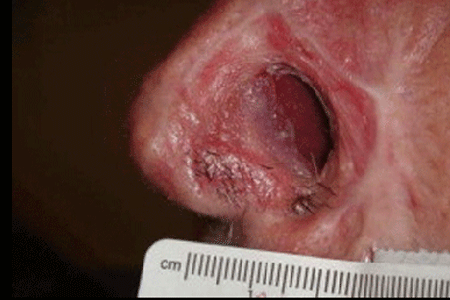
This man chose to treat his skin cancer with black salve, which removed one side of his nose.
Possible side effects of black and red salves include:
- Severe scarring
- Loss of facial structure
- Cancer spreads throughout the body
This is why governments around the world, including those in the United States and Australia, warn against using these natural remedies.
Opting for natural cancer products before trying proven treatment gives cancer time to spread.
When caught early, skin cancer is highly treatable. Even melanoma, the most serious skin cancer, is highly treatable when caught early.
Early skin cancer can often be treated during an office visit while you remain awake. This is often all the treatment that a patient with early skin cancer needs.
Delaying proven medical treatment so that you can try a natural product gives cancer time to grow deeper or spread. This will make medical treatment more difficult later. It may not be possible to remove the cancer.
Vitamins, herbs, and other natural remedies can interfere with cancer treatment your dermatologist prescribes.
Taking a vitamin or supplement? Drinking herbal tea? Trying Chinese medicine? Adding turmeric, ginger root, or another cancer-fighting food to your meals? Tell your dermatologist.
These supplements and foods can interfere with your cancer treatment, making it less effective or even harmful. Here are a few research-proven examples:
- Selenium and vitamins A, C, and E: These can reduce the effectiveness of radiation therapy and many chemotherapy medications.
- Ginger, ginkgo, ginseng, goldenseal, and licorice: These help keep your blood from clotting too easily. If surgery is part of your cancer treatment, consuming any of these may increase your risk of developing uncontrollable bleeding during or after surgery.
- Turmeric: It can interfere with how the body processes certain chemotherapy medications, which may reduce how well a chemotherapy medication works.
These are just a few examples of why it’s essential to tell your dermatologist about all natural products you’re using. Your dermatologist knows when it’s safe for you to take natural products, including supplements.
Natural products and supplements can contain ingredients not stated on the package.
The FDA has found unsafe ingredients in products promoted as “all natural” and in dietary supplements. These unsafe ingredients were not listed on the packaging. For example:
- Some “all natural” products have been found to contain high doses of prescription medications or other pharmaceutical ingredients.
- Some dietary supplements have been found to contain prescription medications, banned substances, or hidden fillers.
Manufacturers add these ingredients to try to improve the effectiveness of their products. They don’t list medication because if they did, the product would have to go to the FDA for review and approval. These omissions are illegal and can be dangerous.
To help protect consumers from unknowingly consuming any of these ingredients, the FDA created the following:
- A health fraud database: You can search this database to see if a product that you’re considering is listed.
- Avoiding products contaminated with hidden ingredients: These tips can help you avoid buying dangerous and illegal products.
Be mindful of product claims, such as “works better than a prescription drug,” “totally safe,” or has “no side effects.”
While these claims can feel reassuring, none are true. Supplements can cause side effects. This means that they’re not “totally safe.” If the product truly worked better than a prescription medication and was safe, doctors would recommend it. In sum, when a claim sounds too good to be true, it usually is.
If you are in a clinical trial, taking vitamins and other supplements can jeopardize clinical trial results.
Researchers carefully select patients to join clinical trials. Strict guidelines are given to patients who join. This often includes not using other medications and products. This guideline helps ensure that the results apply to the people for whom the medication is intended.
If you disregard the guideline and take a supplement or other natural product, it could interact with the medication being studied. You may develop a side effect that would not have occurred if you skipped the natural product. Some side effects can be serious.
If a serious side effect occurs, it could prevent a potentially life-saving treatment from being approved by the U.S. Food and Drug Administration (FDA).
Talking with your dermatologist about your concerns can help you make informed decisions.
Dermatologists are skin cancer experts. They understand this disease, the treatments, and impact it can have on your body and life. It can be helpful to talk with someone who has this much knowledge about your concerns — and ask questions.
Answers from an expert can alleviate your fears and replace worst-case scenarios with facts. Getting the facts can help you make informed decisions about treatment, including if and when to use supplements or other natural products. Dermatologists also know when to use these products during cancer treatment.

When to talk with your dermatologist about natural treatment
Natural products cannot cure skin cancer, and dermatologists don’t recommend using them instead of recommended treatment.
If you’re interested in natural treatment, talk with your dermatologist before using it. A type of therapy called complementary therapy (using medical therapy together with other treatments) can be helpful. For example, a nutritional plan, a supplement recommended by your dermatologist, or stress-reduction techniques, can improve well-being when paired with proper medical care. Your dermatologist knows when pairing medical treatment with other treatment can be beneficial.
Related AAD resources
Skin cancer: Learn about symptoms, how skin cancer is diagnosed, and the causes.
Dermatologist reviewer bios
Shari Lipner, MD, PhD, FAAD
Board certified in dermatology, Dr. Lipner is an internationally recognized dermatologist, research scientist, and teacher. She specializes in nail diseases, including:
Nails affected by psoriasis, lichen planus, or eczema
Nail infections
Nail tumors
As director of the nail division at Weill Cornell Medicine in New York City, Dr. Lipner sees patients and leads clinical trials. Her research has led to new treatments for nail disease.
To date, Dr. Lipner has co-authored more than 750 articles about her research, which have been published in leading medical journals.
Dr. Lipner mentors residents and medical students and is a professor of clinical dermatology at New York-Presbyterian Hospital/Weill Cornell Medical Center in New York City. She is also invited to speak at medical conferences around the world.
Her nail care advice is regularly featured on television and in magazines.
Michael O'Donoghue, MD, FAAD
Board certified in dermatology, Dr. O’Donoghue is known for his expertise in diagnosing and treating complex conditions that affect skin, hair, or nails, including:
Skin cancer
Acne, rosacea, and psoriasis
Blistering diseases
He sees patients at dermatology clinics in the Chicago area. Patients appreciate his patient-first approach, which allows him to prioritize each patient’s unique needs, preferences, and goals when creating a treatment plan. On his practice’s website, he says, “More than anything, I want my patients to feel comfortable and confident in their treatment and in their skin.”
To stay up to date, Dr. O’Donoghue belongs to a group of expert dermatologists, who meet to talk about and share the latest methods and newest treatments in dermatology.
Dr. O’Donoghue also makes time to share his expertise by teaching medical professionals and medical students in the Chicago area.
Temitayo Ogunleye, MD, FAAD
Board certified in dermatology, Dr. Ogunleye is a nationally recognized expert in diagnosing and treating conditions in people who have darker skin tones. These conditions include:
Hair and scalp disorders
Diseases that affect skin pigment, such as vitiligo and melasma
Skin cancer
She sees patients in the Philadelphia area. Her patients say she is friendly and extremely knowledgeable in diagnosing and treating their hair and skin conditions.
Also known for her research, Dr. Ogunleye’s studies have provided new insights that give the field of medicine a better understanding of hair and skin conditions common in darker skin tones. Her research findings have been published in leading medical journals.
At the University of Pennsylvania School of Medicine, she is Professor of Clinical Dermatology and Associate Director of Community Engagement and Academic Excellence in Department of Dermatology.
She is frequently contacted by the media for her expertise.
Written by Paula Ludmann, MS
Paula has more than 20 years of experience writing about skin, hair, and nail conditions for patients and the public.
She enjoys developing easy-to-understand information that people can use to make informed health decisions.
Paula’s passion for creating patient-first information has led to her work being mentioned by Prevention magazine and the Washington Post. She has won numerous awards, including Webbies, Apex Awards, and several awards from professional organizations.
References
Australian Government, Department of Health, Therapeutic Goods Administration. “Black and red salves in treating cancer.” Alert issued: Mar 19, 2012. Last accessed Jul 17, 2026.
Abdin R, Warp PV, et al. “The use of natural therapies in patients with skin cancer: A scoping review.” J Drugs Dermatol. 2024 May 1;23(5):322-6.
Croaker A, Lim A, et al. “Black salve in a nutshell.” Aust J Gen Pract. 2018 Dec;47(12):864-7.
Hidalgo L, Saldías-Fuentes C, et al. “Complementary and alternative therapies in skin cancer a literature review of biologically active compounds.” Dermatol Ther. 2022 Nov;35(11):e15842.
Huebner J, Mohr P, et al. “Use of complementary medicine in metastatic melanoma patients treated with ipilimumab within a clinical trial.” J Dtsch Dermatol Ges. 2016 May;14(5):508-13.
Loquai C, Dechent D, et al. “Risk of interactions between complementary and alternative medicine and medication for comorbidities in patients with melanoma.” Med Oncol. 2016 May;33(5):52.
Loquai C, Dechent D, et al. “Use of complementary and alternative medicine: A multicenter cross-sectional study in 1,089 melanoma patients.” Eur J Cancer. 2017 Jan;71:70-79.
U.S. Food and Drug Administration:
“6 tip-offs to rip-offs: Don't fall for health fraud scams.” Page current as of Mar 4, 2021. Last accessed Jul 17, 2026.
“Medication health fraud and avoiding medication scams with Cynthia Ng.” Page last reviewed Mar 19, 2024. Last accessed May 6, 2026.
“Products claiming to “cure” cancer are a cruel deception.” Page current as of Sep 4, 2020. Last accessed Jul 17, 2026.
Image credit
Used with permission of Journal of the American Academy of Dermatology: J Am Acad Dermatol 2011;65(5);e154-55.