







How to decode a sunscreen label
How to read a sunscreen label
Today’s sunscreens do a lot more than just prevent sunburn. They can help protect against skin cancer and premature aging. But with so many options on the shelf, knowing how to read a sunscreen label is key to choosing the right one for you and your family. To help, dermatologists offer these tips.
Do you find terms on sunscreen confusing? If you answer yes, you’re in good company. A study published in JAMA Dermatology says that fewer than half of the patients at a dermatology clinic knew the meaning of terms like “broad spectrum” and “SPF.”
Some of these terms, such as “broad spectrum” and “SPF,” have very specific meanings because they come from standards created by the U.S. Food and Drug Administration (FDA) for testing sunscreen. Others lack this official meaning, but you’ll frequently see them on sunscreen.
Being able to decipher these terms can help you choose a sunscreen that gives you the protection you expect. You’ll find everything you need to decode a sunscreen label below.
What is broad-spectrum sunscreen?
Broad spectrum means the sunscreen can protect you from both types of harmful UV rays, ultraviolet A (UVA) and ultraviolet B (UVB) rays.
Why do you want to use broad-spectrum sunscreen?
A broad-spectrum sunscreen can protect your skin from the sun's UVA (aging) rays and UVB (burning) rays, which helps prevent:
Skin cancer
Early skin aging (premature age spots, wrinkles, and sagging skin)
Sunburn
What is SPF?
The FDA defines SPF as sun protection factor. The SPF tells you how well a sunscreen protects you from sunburn.
To remember this, you may want to think of the sun protection factor (SPF) as the "sunburn protection factor."
What does the SPF number on sunscreen mean?
The SPF number on sunscreen tells you how much UVB light (the burning rays) a sunscreen can filter out.
Here's what the science tells us about how much UVB light different SPFs can filter out:
SPF 15 filters out 93% of the sun's UVB rays.
SPF 30 filters out 97% of the sun's UVB rays.
The AAD recommends using an SPF 30 or higher.
It’s important to know that no sunscreen can filter out 100% of the sun’s UVB rays. That’s why it’s important to also seek shade and wear sun-protective clothing — such as a lightweight and long-sleeved shirt, pants, a wide-brimmed hat, and sunglasses with UV protection.
For more effective protection, look for clothing with an ultraviolet protection factor (UPF) label.
Dermatologists recommend that you apply sunscreen to all skin not covered by clothing, using a broad-spectrum sunscreen that offers SPF 30 or higher and water resistance.
What is waterproof sunscreen?
There's actually no such thing as waterproof sunscreen. Sweat and water wash sunscreen from our skin, so the FDA no longer allows manufacturers to claim that a sunscreen is waterproof. Some sunscreens are water resistant.
What is water-resistant sunscreen?
When you see “water resistant” on sunscreen, it tells you how long (either 40 or 80 minutes) the sunscreen will stay on wet skin. The sunscreen must undergo testing before it earns a water-resistant designation. Here’s what each FDA designation means:
Water resistant: The sunscreen stays effective for 40 minutes in the water. After that time, you'll need to reapply.
Very water resistant: The sunscreen stays effective for 80 minutes in the water, so you need to reapply after 80 minutes.
Even if your skin remains dry while using a water-resistant sunscreen, you'll need to reapply the sunscreen every 2 hours.
Why reapply sunscreen?
You should reapply your sunscreen as it only lasts so long on your skin. The sun's rays break down some sunscreens. Others clump and lose their effectiveness.
To continue protecting your skin from the sun when outdoors, you must reapply sunscreen:
Every 2 hours
After toweling off
When sweating*
After being in water*
*When using water-resistant sunscreen, you'll need to reapply every 40 minutes. Very water-resistant sunscreen is reapplied every 80 minutes.
On sunscreen, what does “active ingredient” mean?
On sunscreen, “active ingredient” refers to the ingredients that protect your skin from the sun’s harmful ultraviolet (UV) rays. The FDA requires sunscreen manufacturers to list the active ingredients.
Current active ingredients used in sunscreen products in the U.S. include: avobenzone. bemotrizinol (BEMT), ensulizole, homosalate, octinoxate, octisalate, octocrylene, oxybenzone, titanium dioxide, and zinc oxide.
BEMT is the first active ingredient in sunscreen to be approved by the FDA in more than 20 years. The first products containing BEMT hit U.S. shelves in 2026. BEMT was approved for use in Europe in 2000.
What’s the difference between a chemical and physical sunscreen?
The biggest difference between chemical and physical sunscreen is the active ingredients they contain. Here’s the lowdown:
Physical sunscreen: If the active ingredient in your sunscreen is titanium dioxide, zinc oxide, or both, you have a physical sunscreen. Dermatologists recommend physical sunscreen, also called mineral sunscreen, for people with sensitive skin.
Chemical sunscreen: If your sunscreen doesn’t contain titanium dioxide or zinc oxide, you have a chemical sunscreen.
Hybrid sunscreen: These sunscreens contain one or more active ingredients found in chemical and physical sunscreens.
To see what type of sunscreen you have, look at the sunscreen container. You'll find a section labeled “Active Ingredients.”
Whether you have a chemical, physical, or hybrid sunscreen, they all form a protective layer on your skin that absorbs the sun’s rays. In addition to absorbing the sun’s rays, physical sunscreens reflect the sun’s rays.
Any of these sunscreens can effectively protect you from the sun if you select one that offers all the following:
SPF 30 or higher
Broad-spectrum protection
Water resistance
What is tinted sunscreen?
Tinted sunscreen can protect you from a type of light called visible light.
Protection from visible light is especially helpful for people with darker skin tones. The darker your skin tone, the higher your risk that UV rays and visible light from the sun will cause dark spots, also known as hyperpigmentation, on your skin. Visible light also contributes to melasma.
To protect yourself from visible light, dermatologists recommend that you seek shade, wear sun-protective clothing, and apply a broad-spectrum sunscreen that says “tinted” on the label and has an SPF of 30 or higher. Tinted sunscreens contain iron oxide, which research shows helps to protect people’s skin from visible light.
Another benefit of tinted sunscreen is that it can help you avoid a white residue or “cast” left by some sunscreens.
What does the word “sports” mean on sunscreen?
The FDA has not defined the term “sport” for sunscreen.
When you see the word “sport” on sunscreen, it usually means that the sunscreen will stay on wet skin for either 40 or 80 minutes. To be sure, check the label. You may also see the words “water resistant” or “very water resistant.”
To protect your skin, you’ll need to reapply sport sunscreen:
When sweating
After toweling off
After getting out of the water
Every 2 hours (when not sweating or in the water)
What does the word “baby” mean on sunscreen?
Like the word “sport,” the FDA has not defined the term “baby” for sunscreen.
In general, when you see the term "baby" on sunscreen, it means the sunscreen contains only one or more of these active ingredients:
Titanium dioxide
Zinc oxide
These ingredients are less likely to irritate a baby's sensitive skin.
The AAD recommends the following for babies and toddlers:
Children younger than 6 months of age: Protect their skin from the sun by keeping them in the shade and dressing them in long-sleeved shirts, pants, wide-brimmed hats, and sunglasses. Take care to prevent overheating.
If possible, avoid using sunscreen on these children.
Children 6 months of age and older: Use a sunscreen that contains titanium dioxide or zinc oxide. These ingredients are less likely to irritate the sensitive skin of infants and toddlers.
Even when using sunscreen, keep children in the shade and dress them in clothing that will protect their skin from the sun, i.e., long-sleeved shirts, pants, and wide-brimmed hats.
What does the term “sensitive skin” mean on sunscreen?
Again, the FDA does not define the term “sensitive skin” for sunscreen.
In general, if a sunscreen label says, "sensitive skin," it often means that the sunscreen:
Contains one or both of these active ingredients — titanium dioxide and zinc oxide
Does not contain fragrance, oils, PABA, or active ingredients found in chemical sunscreens, which can irritate sensitive skin
Is hypoallergenic
What does the term “reef safe” mean on sunscreen?
“Reef safe” is another term that the FDA has not defined for sunscreen.
“Reef safe” started to appear on sunscreen products after studies suggested that some active ingredients in sunscreen are toxic to coral. These studies have been criticized for testing sunscreen ingredients in unrealistic environments and at unrealistically high concentrations.
The American Academy of Dermatology (AAD) agrees that the scientific evidence available so far about sunscreens and reefs is limited and does not provide clear answers. More studies are needed to know the effect of sunscreen ingredients on reefs.
The AAD supports scientific research that will help us better understand whether sunscreen ingredients could affect our oceans, lakes, rivers and the plants and animals that live in these waters. That’s why the AAD supports a recommendation made by the National Academies of Sciences, Engineering, and Medicine, which recommends that the U.S. Environmental Protection Agency (EPA) conduct scientific study in this area.
The AAD also supports studies to determine how any changes to sunscreen would impact people’s health. We have strong scientific evidence that the sun’s UV rays are a major risk factor for skin cancer. We know it’s important for everyone to protect their skin from the sun.
Is it best to use sunscreen that contains insect repellent?
No. If a sunscreen label says it contains insect repellent, the AAD recommends looking for another sunscreen.
While both products provide important protection, the AAD recommends buying separate products because:
Sunscreen should be applied liberally and often.
Insect repellent should be applied sparingly and less often than sunscreen.
Is sunscreen safe?
Reviewing the safety, effectiveness, and quality of sunscreens is one of the FDA’s responsibilities.
To ensure public safety, the FDA’s standards for sunscreen products are very high. The FDA’s recommendations are based on current scientific evidence, and the science doesn’t show that any sunscreen ingredients now available in the U.S. are harmful to human health.
The FDA is currently looking at sunscreen due to a study that investigated four sunscreen ingredients. The researchers conducting this study concluded that these four ingredients can be absorbed into the body. Additional research is needed to determine whether absorbing any of these ingredients has any effects on a person’s health.
Keep in mind what the researchers pointed out. Just because an ingredient is absorbed into the bloodstream does not mean that it is harmful or unsafe.
Most importantly, the researchers and the FDA concluded that people should continue to use sunscreen to protect themselves from the sun.
Your dermatologist knows sunscreen
If you have other questions about the safety of sunscreen, ask a board-certified dermatologist. These doctors are familiar with the FDA regulations on sunscreen and sunscreen studies in general.
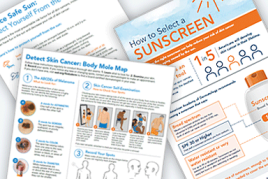
Now that you understand sunscreen lingo, here's a tip sheet that you can use while shopping for sunscreen: How to select a sunscreen.
References
News release, “The latest in sun protection.” Issued Mar 25, 2022. Last accessed Jun 18, 2026.
Cole C, Shyr T, et al. “Metal oxide sunscreens protect skin by absorption, not by reflection or scattering.” Photodermatol Photoimmunol Photomed. 2016 Jan;32(1):5-10.
He X, Jin S, et al. “The emerging role of visible light in melanocyte biology and skin pigmentary disorders: Friend or foe?” J Clin Med. 2023 Dec 4;12(23):7488.
JAMA Dermatology news release, “How much do consumers know about new sunscreen labels?” Release issued June 17, 2015.
Lyons AB, Trullas C, et al. “Photoprotection beyond ultraviolet radiation: A review of tinted sunscreens.” J Am Acad Dermatol. 2021;84(5):1393-7.
Tsatalis J, Burroway B, et al. “Evaluation of ‘reef safe’ sunscreens: Labeling and cost implications for consumers.” J Am Acad Dermatol. 2020 Apr;82(4):1015-17.
U.S. Food and Drug Administration:
“FDA expands sunscreen options for the first time in 20 years.” Content current as of 6/9/2026. Last accessed 6/11/2026.
“Sunscreen: How to help protect your skin from the sun.” Content current as of 6/9/2026. Last accessed 6/11/2026.
“Questions and Answers: FDA posts deemed final order and proposed order for over-the-counter sunscreen.” Content current as of 12/16/2022. Last accessed 6/11/2026.
Wang SQ, Osterwalder U, et. al. “Pending Food and Drug Administration approval of bemotrizinol: A potential turning point for United States sunscreen formulation.” J Am Acad Dermatol. 2026 Apr 29:S0190-9622(26)02569-7.
Zundell MP, Wong M, et al. “Letter to the editor: Improving patient communication on sunscreen choice: Updating mechanistic misconceptions.” J Eur Acad Dermatol Venereol Clin. Pract. 2023;1-2.
Video Reviewed by:
Jennifer Adams, MD, FAAD
Jean Bolognia, MD, FAAD
Charles Dunn, MD, FAAD
Roopal Kundu, MD, FAAD
William Warren Kwan, MD, FAAD
Ata Moshiri, MD, FAAD
Michael K. O'Donoghue, MD, FAAD
Darrell Rigel, MD, FAAD
Desmond Shipp, MD, FAAD
Text reviewed by:
Jennifer Adams, MD, FAAD
Lisa Akintilo, MD, MPH, FAAD
Jean Bolognia, MD, FAAD
DiAnne Davis, MD, FAAD
William Warren Kwan, MD, FAAD
Kelley Pagliai Redbord, MD
Abagail Baird Waldman, MD, FAAD
Written by:
Loren Bullock (video script)
Paula Ludmann, MS (text)
Last updated: 9/21/26