






Squamous cell carcinoma: Outlook and life after treatment
Last updated: January 13, 2026
Dermatologist reviewed: Arturo Dominguez, MD, FAAD; Brittany Oliver, MD, FAAD. Reviewer bios.
What is the outlook for someone who has squamous cell carcinoma of the skin?
The outlook is excellent when found early and properly treated. More than 90% of patients are cured. FDA-approved treatments for advanced squamous cell carcinoma are helping patients live longer.
Here are key facts about a patient’s prognosis:
Squamous cell carcinoma is seldom life-threatening.
When found early and properly treated, squamous cell carcinoma is highly treatable.
Left untreated, squamous cell carcinoma can grow deep. Once this cancer grows deep, treatment is more difficult.
Occasionally, this cancer can come back after treatment. Performing skin self-exams and keeping all follow-up appointments with your dermatologist can help find recurring (comes back) squamous cell carcinoma.
Life after treatment for squamous cell carcinoma
After treatment, your dermatologist will continue to care for you. Anyone treated for skin cancer has an increased risk of developing another skin cancer. Some patients have a high risk of squamous cell carcinoma coming back after treatment. If you do, your dermatologist will tell you.
To keep yourself healthy after treatment, here’s what dermatologists recommend:
Keep your dermatology appointments: During these appointments, your dermatologist will check you for signs of skin cancer. These exams can find skin cancer early, so you can get prompt treatment.
Your dermatologist will also talk with you to get an idea of how well you’re doing after treatment.
Examine your own skin for signs of skin cancer: After treatment, you’ll learn how to examine your skin. Studies show that patients who routinely check their skin find skin cancer earlier.
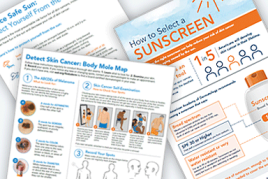
After learning how to perform a skin self-exam, some patients find it helpful to follow a video or look at illustrations that show you what to do. You’ll find both on this page, How to perform a skin self-exam.
To check for hard-to-see places, such as your back, it can be helpful to use a mirror or ask a partner to check these areas.
If you find a spot on your skin, including where you had treatment, that’s growing, bleeding, or changing in any way, contact your dermatologist immediately: Found early and properly treated, skin cancer is highly treatable.
Protect your skin from the sun: After getting skin cancer, many patients feel that the damage has already been done. They don’t see a need to protect their skin from the sun.
Sun protection is essential after treatment. It can prevent new skin cancers.
To protect your skin, dermatologists recommend that you:
- Seek shade: Seek shade when appropriate, remembering that the sun’s rays are the strongest between 10 a.m. and 2 p.m. You can also look at your shadow. Any time your shadow is shorter than you, seek shade.
- Wear sun-protective clothing: Cover up with a lightweight and long-sleeved shirt, pants, a wide-brimmed hat, and sunglasses with UV protection, when possible. Some patients prefer to wear clothing with an ultraviolet protection factor (UPF) number on the label.
Here are tips for choosing UPF clothing and sunglasses:
UPF clothing: Some patients want to know how well their clothes protect them from UV rays, so they buy clothing that comes with an Ultraviolet Protection Factor (UPF) rating. Dermatologists recommend wearing clothing with a UPF rating of 30 or higher.
Sunglasses with UV protection: Sunglasses that offer proper UV protection are labeled “100% UV protection” or “UV400.” When you see one of these statements, it means the sunglasses offer 99-100% UVA and UVB protection. If you’re unsure of the UV protection your sunglasses offer, your optometrist may be able to tell you.
UV protection differs from polarization. Polarization reduces glare.- Always apply sunscreen before going outdoors: To protect your skin, the sunscreen must offer broad-spectrum protection, SPF 30 or higher, and water resistance.
- Apply your sunscreen 15 minutes before going outdoors: You want to apply it to all skin that will not be covered by clothing, including your face, hands, neck, and ears.
- Use enough sunscreen to protect your skin: At a minimum, most adults need about 1 ounce of sunscreen — roughly the amount to fill a shot glass — to fully cover skin not covered by clothing. Depending on your body size, you may need more sunscreen to protect your exposed skin from the sun’s rays.
- When applying sunscreen to your face, use at least 1 teaspoon: This is about the amount needed to cover the length of your index and middle fingers.
- Reapply sunscreen: Do so every two hours and after swimming or sweating.
- Protect your lips: This is a common place for squamous cell carcinoma to develop. Apply lip balm or lipstick that has SPF 30 or higher. Reapply as directed on the container.
Never use a tanning bed, sunlamp, or other indoor tanning equipment: It’s a myth that indoor tanning is safer than the sun. These devices give off radiation that is similar to that of the sun, and in some cases might be stronger.
How to live your healthiest life after treatment
When found early and properly treated, the outlook is generally good for patients with squamous cell carcinoma. Keep in mind that anyone treated for squamous cell carcinoma has a greater likelihood of developing another skin cancer. Examining your own skin for signs of skin cancer, protecting your skin from the sun, and being under the care of a board-certified dermatologist can help you live your healthiest life.
Related AAD resources
Squamous cell carcinoma: From symptoms to treatment: Discover where this skin cancer can appear, how it’s diagnosed and treated, and who’s likely to develop it.
Pictures of squamous cell carcinoma: See different ways this skin cancer can appear on the skin.
Advanced squamous cell carcinoma: Treatment: Learn what advanced means and about newer treatments that are giving patients hope.
Dermatologist reviewer bios
Arturo R. Dominguez, MD, FAAD
Dr. Dominguez is an Associate Professor of Dermatology and Internal Medicine at UT Southwestern Medical Center. Board-certified in both dermatology and internal medicine, he also serves as an attending physician on the internal medicine residency teaching service at Parkland Health & Hospital System in Dallas.
Born and raised in towns along the United States – Mexico border, Dr. Dominguez is dedicated to improving access to medical care in Latino communities. He volunteers monthly at the Agape Clinic in Dallas and performs free skin cancer checks at Latino health fairs.
At the William P. Clements Jr. University Hospital, which has a specialized clinic for transplant patients, he screens patients for skin cancer who are candidates for an organ transplant.
Dr. Dominguez is also involved in clinical trials. These trials focus on severe drug reactions and autoimmune blistering disorders. His research has been published in leading journals including the Journal of the American Academy of Dermatology, JAMA Dermatology, and The British Journal of Dermatology.
Brittany Oliver, MD, FAAD
Dr. Oliver is a board-certified dermatologist and Assistant Professor of Dermatology at the University of Missouri – Kansas City. She has extensive experience treating skin cancer and helping high-risk patients reduce their risk of developing skin cancer. This passion extends to helping everyone reduce their risk and find skin cancer early when it’s highly treatable. To this end, you’ll find her on social media, using science-backed facts to raise awareness. Her posts include tips to help people with darker skin tones find skin cancer earlier. Too often, people who have darker skin tones are diagnosed with skin cancer that has grown large or deep.
Dr. Oliver is regularly featured in online publications, including WebMD, Vogue, and The Wall Street Journal. Castle Connolly, known for its peer-reviewed lists of "Top Doctors," recognizes her as a Rising Star in dermatology.
Written by Paula Ludmann, MS
Paula has more than 20 years of experience writing about skin, hair, and nail conditions for patients and the public.
She enjoys developing easy-to-understand information that people can use to make informed health decisions.
Paula’s passion for creating patient-first information has led to her work being mentioned by Prevention magazine and the Washington Post. She has won numerous awards, including Webbies, Apex Awards, and several awards from professional organizations.
References
Dessinioti C, Stratigos AJ. “Recent advances in the diagnosis and management of high-risk cutaneous squamous cell carcinoma.” Cancers (Basel). 2022 Jul 21;14(14):3556.
Lansdorf AS, Hadaschik EN. “Squamous cell carcinoma and keratoacanthoma.” In: Kang S, Amagai M, et al. Fitzpatrick’s Dermatology (ninth edition). McGraw Hill Education, New York, 2019: 93, 1901-17.
Rojas KD, Perez ME, et al. “Skin cancer: Primary, secondary, and tertiary prevention. “Part II. J Am Acad Dermatol. 2022 Aug;87(2):271-288.