






November is National Healthy Skin Month®
What is National Healthy Skin Month?
The American Academy of Dermatology (AAD) designates each November as National Healthy Skin Month
It’s a time to pay attention to your skin, learn about skin care, and adopt habits that can lead to a lifetime of healthier skin, hair, and nails.

The AAD launched the first National Healthy Skin Month in November 1997. Since then, it’s become an annual event in which the AAD and dermatologists:
Emphasize the importance of good skin care.
Share tips that can lead to healthier skin, hair, and nails.
Encourage you to take time to pay attention to your skin, hair, and nails and adopt healthy habits to care for them.
Who can participate in National Healthy Skin Month?
Everybody needs good skin care — from newborns to people more than 100 years old. That’s why National Healthy Skin Month is everyone’s awareness month.
To help you keep your skin looking its best, this November, the AAD is sharing six skin care tips, along with information to help you decide when it’s beneficial to see a dermatologist.
6 skin care tips for a lifetime of healthier skin
The right care can help you have healthier skin throughout your life. For National Healthy Skin Month, we’re sharing six tips that dermatologists give their patients for a lifetime of healthier skin:
Follow a simple skin care routine. This includes using a gentle cleanser, moisturizer, and sunscreen.
Introduce new skin care ingredients gradually rather than all at once. Using too many products may irritate your skin, especially if you are using more than one anti-aging product.
Use warm water instead of hot water when washing. Hot water can dry your skin, leading to parched, irritated skin.
Exfoliate safely, if you choose to exfoliate. Improper exfoliation can damage your skin, leading to irritated skin, acne breakouts, and other concerns. This video features board-certified dermatologist Charlie Dunn, MD, FAAD, sharing tips, How to exfoliate safely at home.
Protect your skin from the sun’s harmful ultraviolet (UV) rays. Even on cloudy or cool days, the sun's UV rays can damage skin. That’s why the AAD recommends that you:
- Seek shade.
- Wear sun-protective clothing.
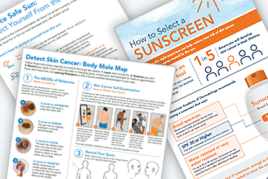
- Apply sunscreen 15 minutes before going outdoors, using sunscreen that offers broad-spectrum protection and SPF 30 or higher.
Check your skin for skin cancer. By checking your own skin, you can find signs of skin cancer early when it’s highly treatable. This video tells you what to look for and how to check your own skin, How to perform a skin self-exam.
When is it time to see a dermatologist?
If you notice a change to your skin, you don’t have to figure out what’s going on alone. Board-certified dermatologists are there to help.
A board-certified dermatologist is trained to diagnose and treat more than 3,000 conditions that affect the skin, hair, or nails. This includes skin cancer.
If you see a spot on your skin that differs from the others, or anything changing, itching or bleeding, the AAD recommends that you make an appointment with a board-certified dermatologist. These can be warning signs of skin cancer. Found early, skin cancer is highly treatable.
Dermatologists also know how to recognize when something that’s happening to your skin may be an indicator of something going on inside your body.
“The skin is a reflection of everything underneath,” says board-certified dermatologist Rachel Nazarian, MD, FAAD. She says, “There are signs on the skin of diabetes, insulin resistance, and many other conditions.” Your skin can even reveal a vitamin or iron deficiency.
Your dermatologist knows how to identify slight differences in the skin, hair, and nails that only become noticeable with years of experience and education. These subtle differences help dermatologists spot signs of everything from poor blood circulation and problems with your liver to lupus and ulcerative colitis.
No one knows your skin better than a board-certified dermatologist. Whenever you have a question or concern about your skin, remember a dermatologist is there to help.
Image
Getty Images
References
American Academy of Dermatology. “National Healthy Skin Month: Why whole-body wellness is more than skin deep.” Issued Nov 2, 2026.
Written by:
Paula Ludmann, MS
Last updated: 11/2/26